Launch day, lorries and the weather
A January launch in the snow, a low seat among lorries and buses, and a battery that disliked the cold. Here is what the testers, the critics and the first owners found.
The Sinclair C5 tricycle, not the Citroën C5. This site is about Sir Clive Sinclair’s battery-assisted tricycle of 1985. See the home page for what it leaves out.
10 January 1985
Sinclair Vehicles launched the C5 on 10 January 1985, priced at £399 including VAT, plus £29 for packing and delivery. Sinclair press kit, 1985
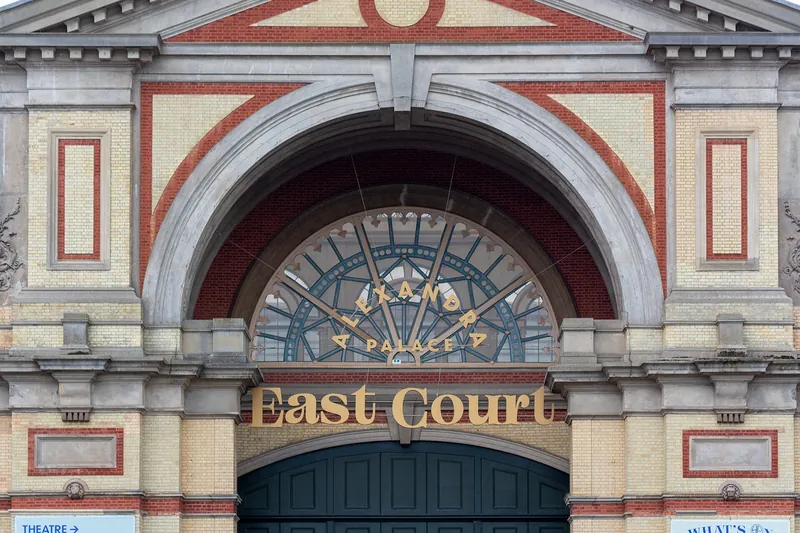
The launch was held in the Pavilion, a temporary hall in the East Court car park at Alexandra Palace in north London, put up while the palace was rebuilt after its 1980 fire. Alexandra Palace
Six C5s burst out of cardboard boxes, driven by models round a purpose-built indoor track. Alexandra Palace
At the launch Sir Clive began by saying what he was not announcing: a conventional car. The C5, he said, was ‘the first stage on the road to an electric car’. Adamson and Kennedy
Alexandra Palace says the steep hills and lying snow round the park made batteries overheat and fail, and even Stirling Moss got into difficulties. Alexandra Palace
Sinclair User reported that test machines driven at the launch gave out halfway up Muswell Hill. Sinclair User, March 1985
Journalists reported that many of the C5s prepared for them were faulty. Hagerty UK, 2025
Hagerty says Moss was stranded when his C5 died on a hill nearby. Hagerty UK, 2025
Moss warned that anyone who sat in it and thought they were in a car ‘because they’re sitting down’ would be in trouble. BBC Future
Before the launch
Because of the secrecy, the only tests on public roads before launch had been at night, with little traffic about. Sinclair User, March 1985
Before the launch James Tye of a campaigning council test-drove it on 6 January 1985. His council sent a critical report to its 32,000 members, and Sir Clive said he would sue; nothing came of the threat. Adamson and Kennedy
The Daily Telegraph’s tester found his head level with the top of a juggernaut’s tyres, with exhaust fumes blowing into his face. Adamson and Kennedy Its first battery, he wrote, ran flat after seven minutes. Adamson and Kennedy
Among the lorries
In tests by the government’s Transport and Road Research Laboratory, lorry drivers could not see a standard C5 just in front of the cab, and there was a blind spot just to the cab’s nearside. TRRL report, 1985
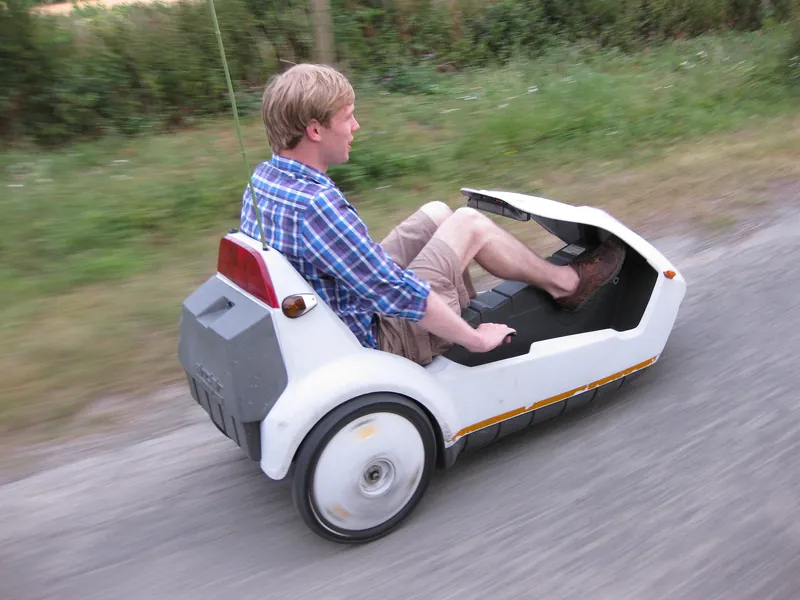
Ridden near the kerb, it took up about 350 mm more of the road than a bicycle. TRRL report, 1985
RoSPA, commissioned by Sinclair to write a booklet on driving it, warned that its low height meant lorry drivers and less alert motorists might not spot it. Sinclair User, March 1985
Even so, RoSPA did not think it should be banned, and said that with the mast it beat bicycles for stability. Sinclair User, March 1985
By night, with 5-watt lamps and a white body, it was relatively easy to see. TRRL report, 1985
The Transport and Road Research Laboratory, TRRL for short, was the government’s own research body. Its 1985 report is the most careful test of the C5 we found.
It was far more stable than a bicycle, though a violent steering input could tip it on its side. TRRL report, 1985
Its brakes were weak when new, at 0.37 g, but reached 0.70 g once bedded in, a figure few bicycles can match. TRRL report, 1985
With only one gear, the motor could trip out on a hill, and the seating could not be adjusted to help pedalling, so a C5 could stop in traffic or even roll back. TRRL report, 1985
Getting out took two to three seconds, even when riders had been told to be ready. TRRL report, 1985
The laboratory concluded that the C5’s overall record on the road might be similar to a pedal cycle’s: better in some respects, poorer in others. TRRL report, 1985
The researchers added that if the bicycle had been invented in 1985 it would probably have been declared unacceptable, so easily do riders fall off. TRRL report, 1985
What the government said
In Parliament the transport minister, Mrs Chalker, said the C5 sat about as low as an open sports car but had conspicuous white bodywork and a very good rear lamp, was impossible to wobble or fall off, and had very effective brakes, wet or dry. Hansard, 4 Feb 1985
The Department of Transport said it was not thought likely to have a worse record than pedal cycles, and that its record would be watched closely. The Guardian, 1985
Wind, rain and cold
Drivers felt exposed not only to passing traffic but to strong breezes and rain. The Guardian, 2021
Sir Clive later admitted January had not been the best time to launch, as the batteries tended to give up in cold weather. The Guardian, 2021
Sinclair’s spokesman said the battery lost 8 to 10 per cent of its efficiency at zero degrees, and more below freezing. Sinclair User, March 1985
The AA’s test on its usual suburban course gave a typical range of ten miles, about half the claim; on a cold day in poor conditions the battery went flat after 6.5 miles. Adamson and Kennedy
In 2010 he told the Independent on Sunday: ‘I rushed at it too much.’ The Guardian, 2021
The verdicts
Which? magazine’s verdict in June 1985: of limited use in its present form, and poor value for money. Adamson and Kennedy
The AA concluded that it looked more comfortable and convenient than it really was. Adamson and Kennedy
In April 1985 the Advertising Standards Authority upheld complaints about the launch advertising, chiefly the claim that it carried far less risk than anything on two wheels. Adamson and Kennedy
Top Gear’s William Woollard said there was nothing the C5 could do that a bicycle couldn’t do more economically and more flexibly. Hagerty UK, 2025
One early buyer, a pensioner, told The Times it would not go up a hill the first time he tried it, so he sent it back. Adamson and Kennedy
Sinclair User noted that even drivers disqualified from driving a car by the courts could use one. Sinclair User, March 1985
The first sales
Sinclair’s spokesman said sales in the first week were ‘fast approaching 1000’. Sinclair User, March 1985
Adamson and Kennedy say it was four weeks after the launch that the company celebrated 1,000 sales. Adamson and Kennedy
How quickly did the first 1,000 sell? Sources differ
- Sinclair’s spokesman said sales in the first week were ‘fast approaching 1000’. Sinclair User, March 1985
- Adamson and Kennedy say it was four weeks after the launch that the company celebrated 1,000 sales. Adamson and Kennedy
The first-week figure was Sinclair’s own spokesman talking up sales; the later date comes from a history written after the collapse.
A month after that, Barrie Wills claimed 5,000 C5s were on the road. Adamson and Kennedy