A computer fortune, a new law and a tricycle
Sir Clive Sinclair had wanted to build an electric vehicle since the 1970s. Money from his home computers, and a 1983 change in the law, turned the idea into the C5.
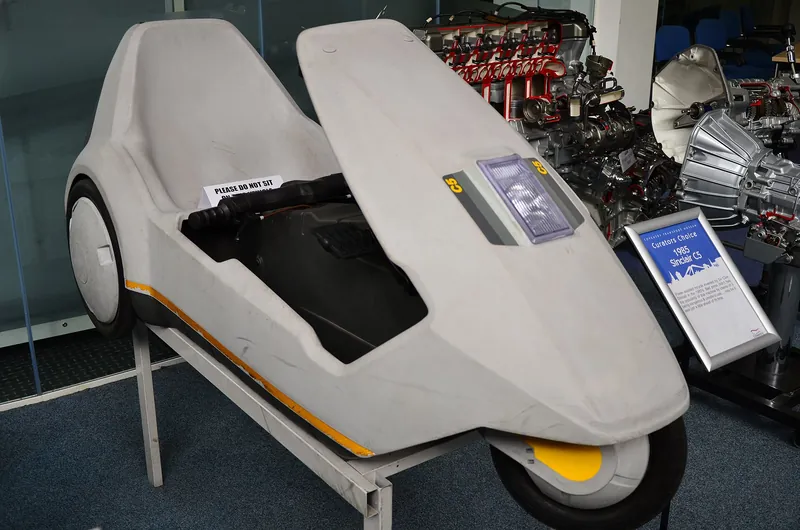
The Sinclair C5 tricycle, not the Citroën C5. This site is about Sir Clive Sinclair’s battery-assisted tricycle of 1985. See the home page for what it leaves out.
An old idea
Sir Clive had the idea as early as the 1970s, at Sinclair Radionics, where he and Chris Curry developed a slimline electric motor. Hagerty UK, 2021
Sinclair’s own launch notes said his work on electric vehicles began in 1973, with a full design programme from 1981. Sinclair press kit, 1985
Sir Clive, 44 at the launch, had founded Sinclair Radionics in 1962 and Sinclair Research in 1979; the ZX81 and ZX Spectrum had each sold more than a million. Sinclair press kit, 1985
The C1: a moped replacement
Hagerty says Sinclair hired Tony Wood Rogers in 1979 to study a ‘personal electric vehicle’ with a 30 mph top speed, known as the C1. Hagerty UK, 2021
Adamson and Kennedy place the hiring of Tony Rogers, a Radionics veteran working as a consultant, early in 1980. Adamson and Kennedy
When was Tony Rogers hired? Sources differ
- Hagerty says Sinclair hired Tony Wood Rogers in 1979 to study a ‘personal electric vehicle’ with a 30 mph top speed, known as the C1. Hagerty UK, 2021
- Adamson and Kennedy place the hiring of Tony Rogers, a Radionics veteran working as a consultant, early in 1980. Adamson and Kennedy
The two dates are only months apart, and both sources agree on the brief: a small town vehicle with a 30 mph top speed.
The brief they quote was for one person, with a second ‘only by squeezing’: a replacement for the moped, for town use, with a top speed of 30 mph. Adamson and Kennedy
A price of £500 was talked about, a quarter of the price of a Fiat 126. Hagerty UK, 2021
In March 1980 the government abolished road tax for all electric vehicles, which made the idea look like a real business. Adamson and Kennedy
Start from the battery
In the press kit Sir Clive argued that others had started from the car and waited for a better battery; Sinclair took today’s battery as given and designed outwards. Sinclair press kit, 1985
Sinclair decided to make do with existing batteries rather than fund a better one, reasoning that a successful electric vehicle would push battery makers to improve their own. Adamson and Kennedy
Exeter, Ogle and the money
Development began in earnest at the University of Exeter in 1982, and Ogle Design, the firm behind the Bond Bug, was brought in to style the C1. Hagerty UK, 2021
In March 1983 Sir Clive sold some of his shares in Sinclair Research, raising £12 million, and formed a new company, Sinclair Vehicles. Hagerty UK, 2021
Adamson and Kennedy say the new company started with £8.6 million of the money from the share sale. Adamson and Kennedy
The press kit itself dates Sinclair Vehicles Ltd to February 1984, at the University of Warwick Science Park, running a vehicle project that Sir Clive had bought from Sinclair Research in 1983. Sinclair press kit, 1985
When did Sinclair Vehicles begin? Sources differ
- In March 1983 Sir Clive sold some of his shares in Sinclair Research, raising £12 million, and formed a new company, Sinclair Vehicles. Hagerty UK, 2021
- The press kit itself dates Sinclair Vehicles Ltd to February 1984, at the University of Warwick Science Park, running a vehicle project that Sir Clive had bought from Sinclair Research in 1983. Sinclair press kit, 1985
Read together: the project moved out of Sinclair Research in 1983 and the company that sold the C5 was set up at Warwick in early 1984. We have not seen a Companies House record to settle the exact dates.
Its managing director was Barrie Wills, 42, who had started as a Jaguar apprentice in 1959, worked at Reliant, and been acting chief executive of DeLorean’s UK side during its 1982–83 receivership. Sinclair press kit, 1985
Before Hoover, Sinclair spent about a year talking to DeLorean’s liquidators about buying the failed carmaker’s Northern Ireland factory. Adamson and Kennedy
A new law
The power to treat assisted cycles as something other than motor vehicles came from section 24 of the Transport Act 1981, and draft rules went out for consultation in 1982. Hansard, 28 Jan 1985
The government told Parliament that several firms, Sinclair Research among them, showed interest while the rules were drafted, but that Sinclair, unlike some, gave it no details of its ideas. Hansard, 28 Jan 1985
Sinclair User described the 1983 change as meant to help disabled drivers and milk float makers. Sinclair User, March 1985
The 1983 Regulations let a tricycle count as a pedal cycle if it weighed no more than 60 kg, had pedals that could propel it, and had no motor except an electric one of no more than 0.25 kW that could not drive it above 15 mph. 1983 Regulations
The Regulations were made on 1 July 1983, laid before Parliament on 8 July and came into operation on 12 August 1983. 1983 Regulations
Sinclair adapted the project to fit the new class, and development carried on through 1984. Hagerty UK, 2021
A 30 mph moped would have needed a licence, tax and insurance. Under the new rules the C5 needed none of them, so long as it kept its pedals, its weight and its power within the limits. For how Britain came to require licences, tests and the Highway Code, see history.motoring.im.
Hagerty notes that the 15 mph limit still shapes the top speed of electric bicycles today. Hagerty UK, 2021
In 2015 the rules changed: the cut-off rose to 15.5 mph, the weight limits went, and machines with more than three wheels were allowed. 2015 amendment memo
Who designed it?
Lotus was brought in for testing, the industrial designer Gus Desbarats was hired to refine Ogle’s shape, and Hoover was to build it. Hagerty UK, 2021
Hagerty’s 40th-anniversary piece credits Ogle Design with the C5’s look, Exeter University with refining its aerodynamics, and Lotus with the final detailing, the last prototypes and the testing. Hagerty UK, 2025
The press kit credits the styling to ‘Guy Desbarats’, a young graduate of the Royal College of Art’s industrial design course. Sinclair press kit, 1985
BBC Radio 5 Live names him Gus Desbarats, hired as a designer at the time. BBC Radio 5 Live
Guy or Gus Desbarats? Sources differ
- The press kit credits the styling to ‘Guy Desbarats’, a young graduate of the Royal College of Art’s industrial design course. Sinclair press kit, 1985
- BBC Radio 5 Live names him Gus Desbarats, hired as a designer at the time. BBC Radio 5 Live
The 1985 press kit says Guy; Hagerty and the BBC say Gus. We use Gus, the name in the more recent sources, but have not seen a primary record that settles it.
By the time Desbarats arrived most of the design was fixed, but he got a high-visibility pole and a little storage behind the driver added. Hagerty UK, 2025
The press kit said the C5 was designed by Sinclair and developed and tested by Lotus Cars. Sinclair press kit, 1985
It adds that Sinclair did almost no market research, relying on Sir Clive’s belief that the market was there. Hagerty UK, 2025
Andrew Marks, writing in the European Journal of Marketing, found the C5 went from drawing board to prototype without any market research. BBC Future
Made by Hoover in Merthyr
Before Hoover, Sinclair spent about a year talking to DeLorean’s liquidators about buying the failed carmaker’s Northern Ireland factory. Adamson and Kennedy
The Welsh Development Agency approached Hoover in spring 1983 to ask whether it would assemble the C5. RCAHMW
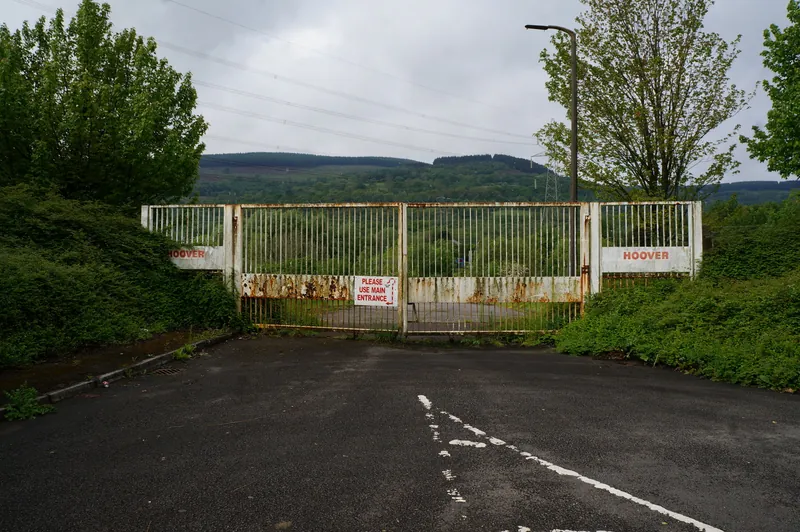
Hoover assembled it at its washing machine factory at Pentrebach, Merthyr Tydfil, which had opened in 1948. RCAHMW
Hoover set aside part of the plant for the C5 and spent £100,000 on a dedicated production line. Adamson and Kennedy
It was built under subcontract at Hoover’s plant in Merthyr Tydfil, South Wales, where production had begun in early November 1984. Sinclair press kit, 1985
On launch day, the press kit said, more than 2,000 had already been built. Sinclair press kit, 1985
The Guardian reported that some 2,500 had already come off the line. The Guardian, 1985
How many were built before the launch? Sources differ
- On launch day, the press kit said, more than 2,000 had already been built. Sinclair press kit, 1985
- The Guardian reported that some 2,500 had already come off the line. The Guardian, 1985
“More than 2,000” and “some 2,500” are close enough that they may describe the same stock counted on different days.
Selling it
At first it was sold only by mail order, from three warehouses, with a 12-month guarantee, battery, charger and courier delivery within 14 to 28 days. Sinclair press kit, 1985
A £3 million advertising campaign backed it. The Guardian, 1985
It was also on show in more than 100 Electricity Board showrooms. Sinclair press kit, 1985
Sinclair expected to build ‘well in excess of 100,000’ C5s in 1985, creating about 200 jobs. Sinclair press kit, 1985
BBC Radio 5 Live says Sir Clive originally hoped to sell a million a year. BBC Radio 5 Live
Timeline
- 1962 Sir Clive, 44 at the launch, had founded Sinclair Radionics in 1962 and Sinclair Research in 1979; the ZX81 and ZX Spectrum had each sold more than a million. Sinclair press kit, 1985
- 1973 Sinclair’s own launch notes said his work on electric vehicles began in 1973, with a full design programme from 1981. Sinclair press kit, 1985
- March 1980 In March 1980 the government abolished road tax for all electric vehicles, which made the idea look like a real business. Adamson and Kennedy
- 1982 Development began in earnest at the University of Exeter in 1982, and Ogle Design, the firm behind the Bond Bug, was brought in to style the C1. Hagerty UK, 2021
- March 1983 In March 1983 Sir Clive sold some of his shares in Sinclair Research, raising £12 million, and formed a new company, Sinclair Vehicles. Hagerty UK, 2021
- Spring 1983 The Welsh Development Agency approached Hoover in spring 1983 to ask whether it would assemble the C5. RCAHMW
- 12 August 1983 The Regulations were made on 1 July 1983, laid before Parliament on 8 July and came into operation on 12 August 1983. 1983 Regulations
- February 1984 The press kit itself dates Sinclair Vehicles Ltd to February 1984, at the University of Warwick Science Park, running a vehicle project that Sir Clive had bought from Sinclair Research in 1983. Sinclair press kit, 1985
- November 1984 It was built under subcontract at Hoover’s plant in Merthyr Tydfil, South Wales, where production had begun in early November 1984. Sinclair press kit, 1985
- 10 January 1985 Sinclair Vehicles launched the C5 on 10 January 1985, priced at £399 including VAT, plus £29 for packing and delivery. Sinclair press kit, 1985
Next: how the C5 worked →